
Research Priorities Generated
by the JEAP Initiative Community Boards
Top 18 Research Priorities
The JEAP Initiative's top 18 research priorities (out of 45 total) are listed below. Click the button below to download the full list.
KEY:
 Justice-Involved Board
  Provider and Payor Board
  Young Adult Board
These icons indicate which Community Board(s) brought up these ideas in their brainstorming sessions.
#1
How can recovery support services help individuals who face barriers to care—such as those who don’t meet medical necessity for detox, experience psychiatric symptoms stemming from substance use, or use non-opioid substances like methamphetamine—and how can these services expand access and fill critical gaps in the recovery journey?

#2
What are current best practices for delivering recovery support services in prisons or jails, and how might those services be improved?

#3
How does criminalization of substance use impact people’s access to various services (e.g., housing, SNAP, education funds) that support recovery?
#4
What policies, procedures, or laws (agency, statewide, or national) create barriers for people with a criminal record to build a recovery-supportive social network that may include other people with a criminal record?
#5
How can recovery support services help to coordinate and create a continuity of care for people reentering society from incarceration, including emerging adults?
#6
Does offering multiple services (that include recovery support services) in one physical location increase effectiveness, for example, by removing transportation barriers?

#7
What combination or sequence of services, including recovery support services, have the most impact on outcomes—including items beyond return to use or recidivism, such as reduced healthcare costs, child welfare system costs, improved housing and economic stability, etc.?
#8
What are the best practices for peer-delivered reach-in services within jails and prisons prior to release, and what benefits do virtual models offer—such as enabling peer matching or expanding access in rural or hard-to-reach facilities?
#9
How does engaging loved ones in recovery support services impact participation and outcomes?

#10
How can recovery support services best address culturally relevant dynamics for substance use (e.g., intergenerational trauma, discrimination) for underserved communities and intersecting identities?

#11
What assessment tools work best to match individuals with needed recovery support services?
#12
What barriers do underrepresented groups face upon reentry, and how can recovery support services help mitigate their impact?
#13
What are best practices for incorporating trauma-informed care into recovery support services, including for special populations like young adults and those involved in the criminal legal system? What are the key ingredients of trauma-informed care in these contexts?
#14
What are the returns on investment for peer recovery support services in the reentry context regarding issues like recidivism, access to housing, employment, and education? Are there special considerations for emerging adults?
#15
What factors increase criminogenic risk, and what recovery support services might help address these factors?
#16
What are the most important outcomes to track to establish the financial benefits of recovery support service programs relative to their costs?
#17
What are the most effective support plans for peer support specialists to manage substance use triggers and trauma for both themselves and those they serve?
#18
Given the rapid growth of digital health platforms (e.g., virtual peer services, recovery chatbots), how do these tools impact barriers, engagement, and recovery across diverse populations, including emerging adults and those with criminal legal system involvement?


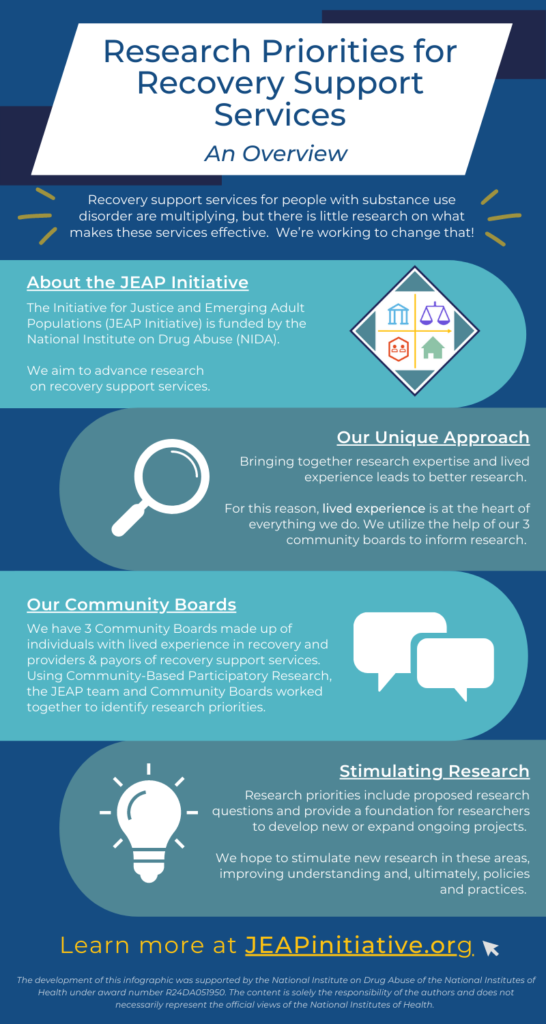
Click here to view an infographic overview of the research priorities
Sign Up for Updates
Hear about job openings, trainings, mentorship opportunities, and other ways to get involved by subscribing to the JEAP Initiative newsletter.
Contact Us
Let us know if you have any questions about this resource or are working on a study that relates to one of these topics - we'd love to hear about it!